A modern, resilient energy grid is essential to providing reliable power to communities across the state. To help promote stronger grid resilience, the Department of Energy (DOE), under the Bipartisan Infrastructure Law, created the Grid Resilience Grant Program to improve the country’s energy infrastructure against extreme weather and natural disasters.
Grid resilience grants provide state utilities and electric cooperatives funds to modernize aging infrastructure without placing the full financial burden on customers or local ratepayers. By offsetting capital costs for system upgrades, these grants strengthen reliability while protecting financial stability.
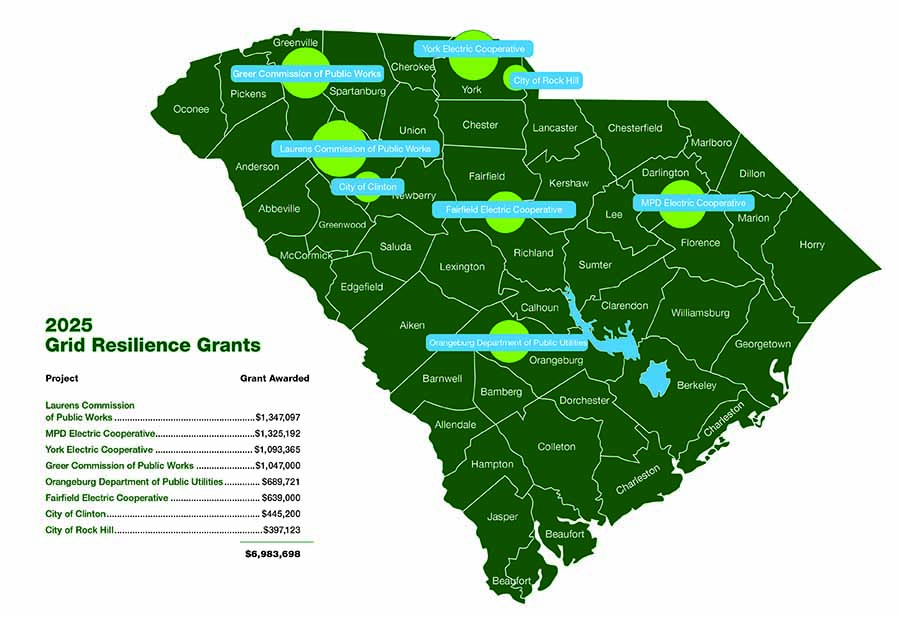
Santee Cooper is administering the formula grant provided to South Carolina through the Bipartisan Infrastructure Law, section 40101(d). In 2025, Santee Cooper distributed the second round of grants to 14 projects, totaling $6.9 million in funding. These grants were awarded to electric cooperatives and municipal and other utilities from across South Carolina.
Together, the projects represent grid improvements that will reduce the number of outages and improve restoration times during extreme weather events, primarily in disadvantaged areas of the state. As part of the selection process, Santee Cooper and an independent consultant, Guidehouse, reviewed and scored the project submissions. The scoring criteria was based on metrics included in the request for proposal (RFP). The selected projects that Santee Cooper submitted to and were approved by the DOE reflect funding available for federal fiscal year 2024. The DOE approval cleared the way for project work to begin.
“These 14 projects represent a powerful step forward in strengthening South Carolina’s electric grid, especially in communities that are most vulnerable to outages,” said Jimmy Staton, President and CEO of Santee Cooper. “We’re proud to partner with the Department of Energy and utilities across the state to deliver smarter, more resilient energy solutions for South Carolinians.”
The awarded projects are:
City of Clinton: $445,200
Vegetation management, outage management and pole inspections.
City of Rock Hill: $397,123
Installing new underground electric lines, equipment and lighting in a 10-foot easement acquired from affected property owners. Old overhead lines will be converted to new underground lines and old infrastructure will be removed.
Fairfield Electric Cooperative: $99,000
Implementing a comprehensive Fault Indicator System to enhance grid resilience by enabling rapid detection, precise location and efficient management of faults.
Fairfield Electric Cooperative: $210,000
Installing seven three-phase electronic reclosers on a distribution circuit from Fairfield's Winnsboro substation.
Fairfield Electric Cooperative: $330,000
Installing 11 three-phase electronic reclosers on a distribution circuit from Fairfield's Woodward substation.
Greer CPW: $1,047,000
Increasing system automation capable of providing real-time data during events, fault identification, fault isolation and service restoration during extreme weather events and other outages.
Laurens CPW: $1,347,097
Replacing the primary and secondary electric distribution lines with new conductor and accelerating vegetation management in the disadvantaged communities of the city.
MPD Electric Cooperative: $319,104
Installing distribution management and automation systems. Compact Modular Reclosers will be installed, along with Remote Control Units, in order to automatically clear instantaneous and short duration faults.
MPD Electric Cooperative: $286,045
Increasing grid resilience in rural communities by upgrading existing single-phase electrical lines to either V-phase or three-phase configurations to improve the efficiency and reliability of the power distribution system.
MPD Electric Cooperative: $720,043
Replacing old or damaged utility poles with new poles to enhance reliability and safety and updating infrastructure to lower the System Average Interruption Duration Index (SAIDI) and Customer Average Interruption Duration Index (CAIDI) during normal and extreme events.
Orangeburg DPU: $689,721
Implementing remote sensing solutions for vegetation; replacing transmission conductors and poles, insulators, static lines and other ancillary material; replacing older electrochemical recloser with a new electronic device.
York Electric Cooperative: $539,956
Changing existing Power-Line-Carrier (PLC) meters to Advanced Metering Infrastructure (AMI) meters.
York Electric Cooperative: $479,921
Changing existing PLC meters to AMI meters.
York Electric Cooperative: $73,488
Creating a Distribution Automation system between York Electric's substations.