Ground Floor Management
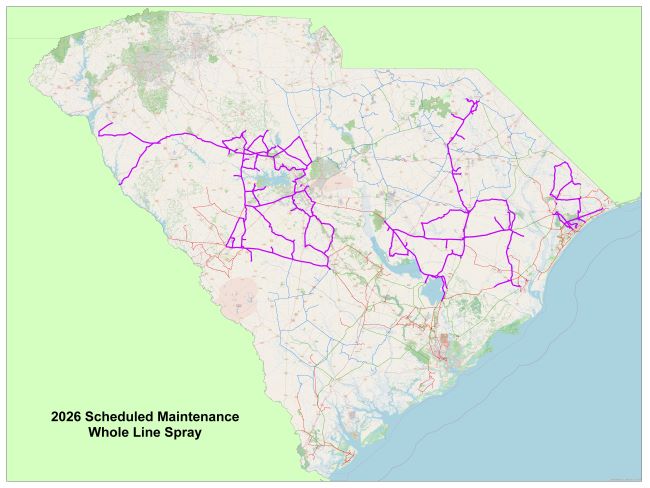
Vegetation management operations and locations are contingent upon weather and ground conditions.
For additional information, please submit any questions to vegetationmanagement@santeecooper.com.
Santee Cooper manages vegetation across transmission rights of way through an Integrated Vegetation Management (IVM) program designed to promote electric reliability, public safety, and long-term environmental stewardship. This program operates on a multi-year cycle, typically every 30 to 36 months, helping ensure compliance with federal reliability standards while maintaining safe clearance around transmission infrastructure.
A key component of Santee Cooper’s vegetation management strategy is the selective application of herbicides. Each year, more than 13,000 acres are treated statewide using United States EPA-registered and approved herbicides. Herbicide application is an effective and environmentally responsible method for controlling incompatible vegetation that could threaten transmission lines and cause power interruptions. By targeting undesirable species while preserving compatible low-growing vegetation, herbicide treatments help reduce the need for repeated mechanical clearing and support improved biological diversity within the right of way.
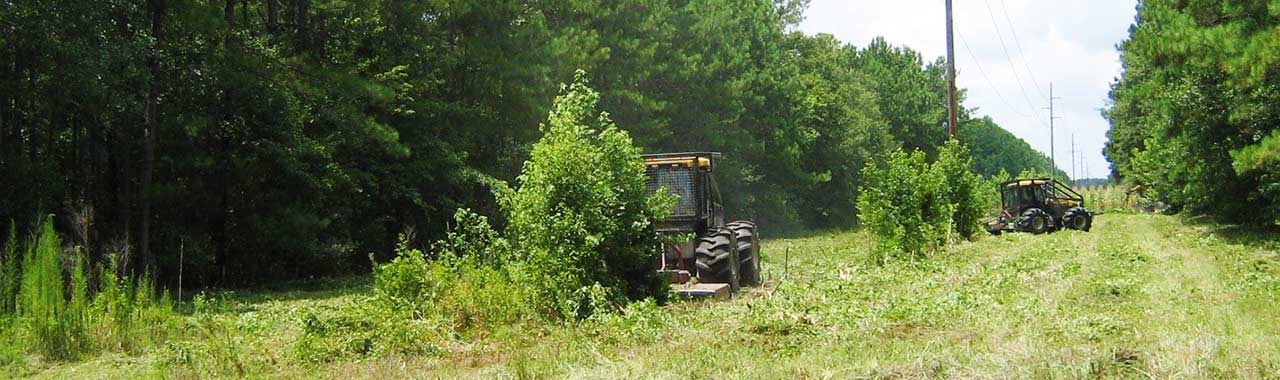
Santee Cooper’s IVM program may also include mechanical re-clearing methods such as tractors, brush mowers, and saws when necessary. However, herbicide application remains one of the most efficient and sustainable tools for maintaining transmission corridors over the long term.
Vegetation management activities near residential and commercial properties are common and essential to maintaining a safe and reliable electric system. Because working around power lines is extremely dangerous, only trained and qualified utility vegetation management professionals should perform this work. The Santee Cooper Right of Way Department and its line clearance contractors have extensive experience in utility arboriculture and transmission corridor management.
Frequently Asked Questions
Vegetation Management practices are implemented based on many contributing factors such as public and employee safety, geographical location, site characteristics, cost effectiveness, brush density, etc.
Herbicide application methods have been proven safe and very beneficial in the utility industry. This method originally was applied to more congested regions of the state but has since expanded.
Mechanical re-clearing methods have been proven to be a cost-effective method and are primarily used in the less congested regions of the state. It is an effective method to ensure reliability and removing larger vegetation.
As a form of right of way maintenance, we have diverse methods of managing or keeping our rights of way clear. Santee Cooper uses a herbicide mixture (all EPA approved) to target only undesirable vegetation in an effort to leave grasses/native plants within its habitat. This is primarily done by men toting backpack sprayers applying a low volume backpack mixture, by mechanical methods, or a combination of both. All applications are designed to control woody stemmed species while promoting biological diversity. Our herbicide application program is on a three-year rotation throughout various areas around the state.